Call us now :08045814267
 Send Inquiry
 Send Inquiry
Hydraulic Lifting Table
Hydraulic Lifting Table Specification
- Handle Type
- Push Handle
- Wheel Type
- Swivel PU Casters
- Control System
- Manual Lever or Electric Control
- Lifting Speed
- Approx 25 mm/s
- Equipment Type
- Hydraulic Lifting Table
- Features
- Overload Protection, Easy to Operate
- Rotation Type
- Not Rotatable
- Motor Type
- Hydraulic Cylinder
- Forklift
- No
- Condition
- New
- Lifting Capacity
- 1000 kg
- Max. Lifting Load
- 1000 kg
- Max. Lifting Height
- 1500 mm
- Power Source
- Hydraulic Manual or Optional Electric Pump
- Power Consumption
- 0.75 kW
- Voltage
- 220V
- Feature
- Height Adjustable, Corrosion Resistant
- Attributes
- Heavy Duty, Portable
- Brake Type
- Foot Operated Wheel Brakes
- Material
- Mild Steel
- Number of Wheels
- 4
- Application
- Material Handling, Warehousing, Assembly Operations
- Safety Lock
- Yes
- Net Weight
- Approx 110 kg
- Table Surface Finish
- Powder Coated
- Platform Size
- 1000 mm x 510 mm
- Minimum Table Height
- 350 mm
- Pump Type
- Single Acting Manual Hydraulic
Hydraulic Lifting Table Trade Information
- Main Export Market(s)
- Asia, Australia, Central America, North America, South America, Eastern Europe, Western Europe, Middle East, Africa
About Hydraulic Lifting Table
SPECIFICATION
|
Item Code No. |
Cap in Kg. |
Platform Size |
Overall Width & Length |
Closed Height |
Max Height |
|
ABM-MH-6250 |
1000 |
700 x 1550 |
1000 x 2100 |
325 |
1225 |
|
ABM-MH-6251 |
2000 |
750 x 1600 |
1050 x 2150 |
350 |
1250 |
|
ABM-MH-6252 |
3000 |
800 x 1650 |
1100 x 2200 |
375 |
1275 |
Optimized for Heavy Duty Operations
Designed to accommodate loads up to 1000 kg, this hydraulic lifting table excels in demanding material handling, warehousing, and assembly tasks. The sturdy mild steel construction, coupled with an advanced hydraulic lifting mechanism, guarantees precise and safe elevation of goods, even in fast-paced industrial environments.
Enhanced Safety and Control Features
The table incorporates critical safety elements, including overload protection, a secure safety lock, and foot-operated wheel brakes. Operators benefit from intuitive controls using a manual lever or optional electric system, ensuring precise height adjustment and movement, minimizing workplace hazards.
Portability and Ergonomic Design
Fitted with four swivel PU caster wheels and a push handle, maneuvering the table across different work areas is effortless. Compact and portable, this lifting table is easy to integrate into varied workflows, providing flexibility and ergonomic support while reducing manual strain for users.
FAQs of Hydraulic Lifting Table:
Q: How do you operate the hydraulic lifting table to adjust its height?
A: The tables height is adjusted using the single-acting manual hydraulic pump by engaging the manual lever. For models equipped with the optional electric control, users activate the electric pump to raise or lower the platform with precision, accommodating loads up to 1000 kg.Q: What are the main applications of this hydraulic lifting table?
A: This table is ideal for material handling in warehouses, assembly lines, and industrial environments. It facilitates lifting, transferring, and positioning of heavy goods, increasing efficiency and safety in various manual operations.Q: When is the use of the safety lock and brake mechanism recommended?
A: The safety lock and foot-operated brakes should always be engaged when the table is stationary, during loading or unloading, or whenever maintenance is performed. These features prevent accidental movement and enhance operator safety.Q: Where can this hydraulic lifting table be effectively utilized?
A: It is best suited for warehouses, production assembly settings, distribution centers, and anywhere heavy lifting and ergonomic height adjustment are needed. The tables portability also allows it to be used across multiple work areas as required.Q: What is the process for maintaining the hydraulic lifting table?
A: Routine maintenance involves checking for hydraulic fluid levels, inspecting wheels for wear, ensuring the safety lock and brakes function properly, and keeping the powder-coated surface clean to guard against corrosion.Q: What benefits does the corrosion-resistant finish provide?
A: The powder-coated surface offers reliable protection against rust and wear, prolonging the tables lifespan and ensuring it maintains structural integrity even in humid or challenging industrial environments.Q: How does overload protection enhance the usage of the lifting table?
A: Overload protection is built in to prevent accidental hoisting of loads beyond the rated 1000 kg capacity. This feature protects both operators and equipment, ensuring safe daily use and reducing risk of mechanical failure.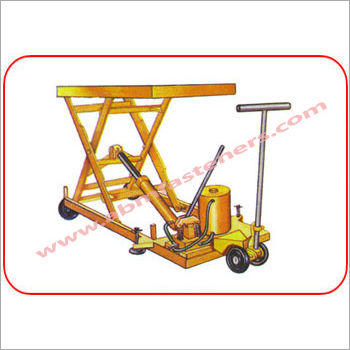
Tell us about your requirement

Price:
Quantity
Select Unit
- 50
- 100
- 200
- 250
- 500
- 1000+
Additional detail
Mobile number
Email


 Send Inquiry
Our Products
- Fastener Making Machinery
- High Speed Automatic Bolt Making Plant / Machine
- Automatic Nut Making Machine
- High Speed Automatic Machine Screw Making Plant
- Wire Drawing Plant
- Steel Ball Plant
- Automatic Rivet Making Machine
- Automatic Blind (Pop) Rivet Making Plant
- Automatic Wire Nail Panel Pin Making Plant
- Shoe Tack Making Machine
- Horse Shoe Nail Making Machine
- Umbrella Washer Head Roofing Nail Making Machine
- Automatic U Nail Making Machine
- Automatic Paper Pin Making Machine
- Staple Pin Making Machines
- Material Handling Equipment
- Electric Chain Hoist
- Manual Chain Block
- Wire Rope Electric Hoist
- Hand Operated Crab Winch
- Electrical Power Operated Winch Machine
- Gantry Crane
- Fixed and Moveable Jib Crane
- Hydraulic Lifting Table
- Hydraulic Mobile Floor Crane
- Hydraulic Pallet Truck
- Hydraulic Stacker
- All Products


Block RZQ, Plot No. 132/6, Gurudwara Road,New Delhi - 110041, India

 Send Inquiry
 Send SMS
Developed and Managed by Infocom Network Private Limited.
